About Lehe
乐于心,和与众,与己乐,与人和; 心宽念纯,百病无生。


乐于心,和与众,与己乐,与人和; 心宽念纯,百病无生。


Recently, a news story titled "Woman with No Abnormalities in Physical Exams for 10 Years Diagnosed with Advanced Cancer" has been trending on social media. In the news, the woman's physical examination reports over the years all showed normal levels of carcinoembryonic antigen (CEA), a tumor marker in the blood, but she was ultimately diagnosed with advanced kidney cancer .
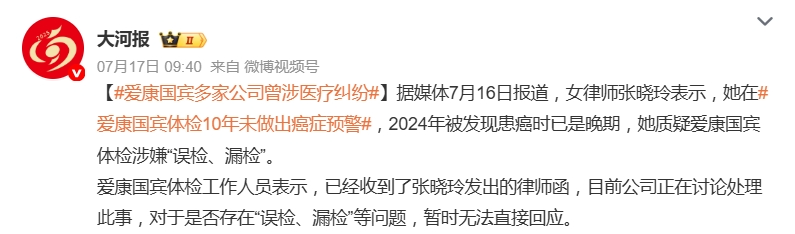
Many people have begun to doubt , can tumor markers still be used as a means of cancer screening?
The answer is yes!
Clinically, imaging is commonly used for screening specific cancers. However, as a biochemical examination method, tumor markers are actually more sensitive than imaging for cancer screening. Frontiers in Surgery research shows that the sensitivity of CEA (a type of tumor marker) in stage I lung cancer is 56.7%, while the missed diagnosis rate of low-dose CT (LDCT) for < 6mm solid nodules is 15%. Combining CEA and CYFRA21-1 can increase the sensitivity of early lung cancer screening to 90%, significantly higher than that of CT alone at 78%. [1]
Different cancers produce different tumor markers. For example, pancreatic cancer is associated with elevated CA199 levels, while intestinal cancer is accompanied by elevated CEA levels. In the news, carcinoembryonic antigen (CEA) is a type of tumor marker, but it is not associated with kidney cancer indicators in any way with kidney cancer .
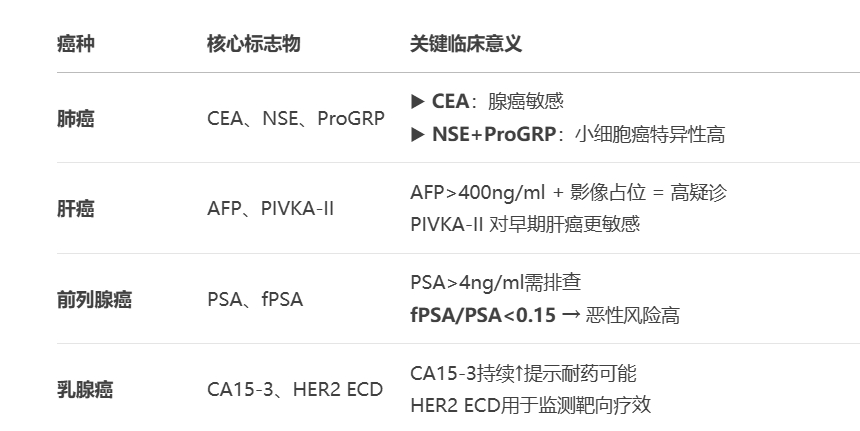
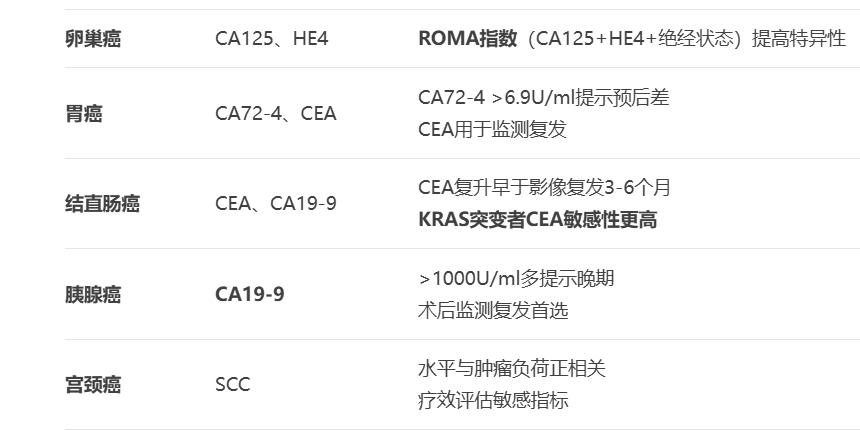
Of course, cancer screening cannot rely solely on a single tumor marker. Because the characteristics and concentrations of tumor markers are influenced by various biological factors, such as post-treatment, host heterogeneity, age, the presence of other diseases in different individuals, false-positive biomarkers produced by other physiological or pathological processes, and exogenous interfering substances. [2]
That is to say
▶An increase in a marker does not necessarily mean a confirmed cancer.
This also precisely illustrates that tumor markers are highly sensitive to changes in health status. Generally, normal adults do not produce tumor markers. Once tumor markers are detected , it indicates that your body has inflammation or may be suffering from cancer. In this case, it is necessary to pay high attention and undergo a thorough physical examination based on the type of tumor markers.
Of course▶Diagnosingcancersymptomsalso≠signsof elevatedmarkersincreasedafter chemotherapy, which is puzzling for some cancer patients. They may wonder: How can tumor markers not be detected before chemotherapy but continue to rise afterward? This is because tumor cells exhibit heterogeneity. If the cancer cells in certain tumor tissues are not very aggressive or the proportion of cancer cells capable of producing tumor markers is small, it is not enough to cause changes in tumor markers. As most of the less aggressive cancer cells are eliminated by chemotherapy, the residual cancer cells that are still viable in the body are prone to producing tumor markers.
The video features Professor Zhang Minghui, an immunology expert from Tsinghua University, explaining abnormal tumor markers
. There is also a situation where, after a certain stage of cancer treatment, the tumor marker values remain persistently high. This is ▶a manifestation of tumor resistance . In such cases, don't panic. Faced with this dilemma, Professor Zhang Minghui, an immunology expert from Tsinghua University, and his company, Lexin New Medical, have found a new direction: vNKT cell immunotherapy. This therapy involves collecting immune cells from healthy individuals, culturing and expanding them, and then infusing them back into the patient's body, without relying on a single target to kill tumor cells, thus circumventing the limitations of traditional chemotherapy drug resistance
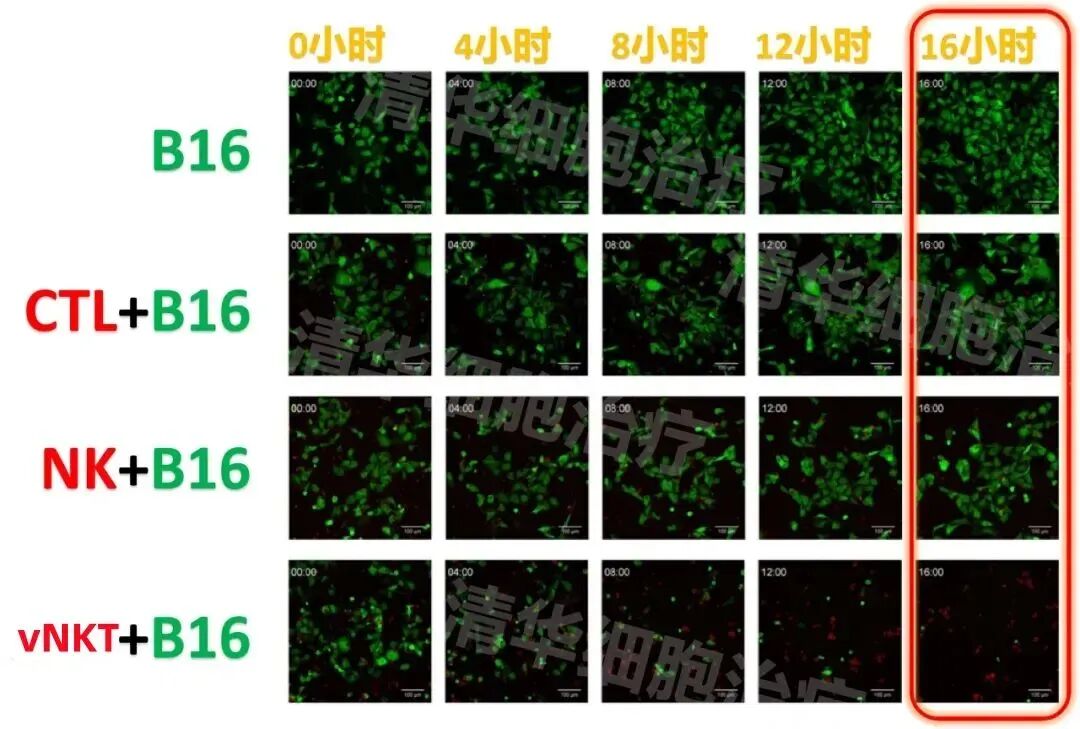
Experimental conditions: Compared to other immune cells, after 16 hours, vNKT cells nearly killed all B16 tumor cells!
Tumor markers are a sign of malignant tumors and a weapon that tumors use to suppress the body's immune system. When dealing with tumor marker indicators, one should neither rely solely on them nor ignore them. Understanding its warning language and using tumor markers correctly and accurately, can win the initiative for life , and prevent the tragedy of missed detection from happening again in the trending searches.
ReferenceSource: [1]
Casiraghi M. Diagnostic Value of Imaging Combined With Tumor Markers in Early Detection of Lung Cancer [J]. Frontiers in Surgery, 2021, 8:694210. DOI:10.3389/fsurg.2021.694210
[2]Zhou Y, Tao L, Qiu J, Xu J, Yang X, Zhang Y, Tian X, Guan X, Cen X, Zhao Y. Tumor biomarkers for diagnosis, prognosis and targeted therapy. Signal Transduct Target Ther. 2024 May 20;9(1):132. doi: 10.1038/s41392-024-01823-2. PMID: 38763973; PMCID: PMC11102923.
Click to view previous exciting content




Address: Room 1101 (Unit 101), 11th Floor, Building 1, No. 7 Courtyard, Kexueyuan Road, Life Science Park, Changping District, Beijing
Phone:010-8265 9866
Email:lehemedneo@hotmail.com